The short answer
The FDA sets the Daily Value for dietary fiber at 28 grams a day (based on a 2,000-calorie diet), and the Dietary Guidelines for Americans recommend about 14 grams of fiber for every 1,000 calories you eat. By the government's own estimate, more than 90 percent of women and 97 percent of men do not reach that level, which is why fiber is officially listed as a nutrient of public health concern. The gap is usually 10 to 15 grams a day. Beans, vegetables, fruit, whole grains, nuts and seeds close most of it; a pre-portioned after-meal habit such as one Hinuki fiber jelly stick (about 4.2 g, or 15% of the Daily Value) is the simplest way to cover the rest.
Fiber advice is everywhere, and most of it is vague: "eat more fiber", "aim for plenty of whole grains". The official recommendations, however, are surprisingly specific, and once you know the actual numbers it becomes much easier to see where you stand and what a realistic fix looks like. This guide walks through what the two main U.S. sources say, how to read them on a label and in your own meals, and how to close the gap without turning every meal into a bowl of bran.
The two official numbers you should know
1. The FDA Daily Value: 28 grams
Every Nutrition Facts panel in the United States shows fiber as a percentage of a Daily Value. That reference figure is 28 grams of dietary fiber per day, set by the FDA for Nutrition and Supplement Facts labels and based on a 2,000-calorie diet. When a label says a serving has 15% DV of fiber, that is about 4.2 grams. The Daily Value is a label benchmark rather than a prescription for every individual, but for most adults it is a sensible everyday target.
2. The Dietary Guidelines for Americans: 14 grams per 1,000 calories
The Dietary Guidelines for Americans, published jointly by the USDA and HHS, express fiber relative to how much you eat: about 14 grams for every 1,000 calories. For a woman eating around 1,800 calories that is roughly 25 grams; for a man eating 2,400 calories it is about 34 grams. The guidelines also deliver the uncomfortable headline: more than 90 percent of women and 97 percent of men do not meet recommended intakes, which is why dietary fiber is named a "dietary component of public health concern" for underconsumption.
| Source | What it says | What it means for you |
|---|---|---|
| FDA Daily Value | 28 g per day (2,000-calorie reference) | The number behind every "% DV" for fiber on a label |
| Dietary Guidelines for Americans | 14 g per 1,000 calories; fiber is a nutrient of public health concern | Roughly 22–34 g a day depending on age, sex and calories |
| FDA label claims | "Good source" = 10–19% DV per serving; "High" or "excellent source" = 20% DV or more | A quick way to spot foods that pull real weight |
| Typical U.S. intake (national surveys) | Around 15 g a day on average | A gap of roughly 10–15 g for most adults |
Why so many people fall short
The gap is not a lack of knowledge; it is a plate problem. The foods that carry the most fiber in the Dietary Guidelines' recommended eating pattern, meaning beans, peas and lentils, vegetables, whole fruit, whole grains, nuts and seeds, are exactly the foods that the typical American eats least. Meanwhile the foods that fill most plates, such as refined bread and pasta, white rice, meat, cheese, sweetened drinks and packaged snacks, contain little or no fiber at all. Add a schedule in which breakfast is coffee, lunch is a sandwich and dinner is whatever is fast, and 15 grams a day happens almost automatically.
There is also a second, quieter reason: fiber intake is spread unevenly through the day. Many people eat nearly all of theirs at dinner, which means breakfast and lunch do little for fullness. That is one reason the mid-afternoon snack hunt is so common, as we explain in why you still crave snacks after a full meal.
What the gap looks like on a plate
Numbers are abstract, so here is what the difference between 15 and 28 grams looks like in food. Each of the following adds roughly 3 to 8 grams of fiber:
- Half a cup of cooked black beans or lentils: about 7–8 g.
- One medium pear or apple with the skin: about 4–5 g.
- One cup of cooked broccoli or Brussels sprouts: about 4–5 g.
- Half a cup of dry oats, cooked: about 4 g.
- One ounce of almonds or chia seeds: 3–4 g for almonds, closer to 10 g for chia.
- Two slices of 100% whole-grain bread instead of white: about 4 g more.
Three of those swaps, spread across the day, close the gap for most people. The hard part is not the math; it is doing it every day, including the days you eat out, travel or simply forget.
How to apply the guidelines in a normal day
The Dietary Guidelines recommend meeting fiber needs mainly through whole foods, and we agree. Below is a realistic day that reaches about 28 grams without unusual foods. The percentages use the FDA Daily Value.
| Meal | What's on the plate | Fiber (approx.) |
|---|---|---|
| Breakfast | Oatmeal made with 1/2 cup oats, 1 tablespoon chia seeds, a handful of berries | 9 g (about 32% DV) |
| Lunch | Sandwich on two slices of whole-grain bread with turkey, lettuce and tomato, plus an apple | 8 g (about 29% DV) |
| Dinner | Chicken or fish with 1/2 cup lentils or beans and a cup of roasted vegetables | 10–12 g (about 36–43% DV) |
| After the main meal | One Hinuki fiber jelly stick | 4.2 g (about 15% DV) |
Notice how the last line works: the stick is not doing the heavy lifting, the food is. But it adds a fixed, predictable 15% of the Daily Value every single day, including on the days when lunch was a slice of pizza. That reliability is exactly what most people are missing. If your current intake is low, follow the official advice to increase gradually and drink water; our 14-day plan for adding fiber without bloating shows how.
Reading the label the way the FDA intends
Because the Daily Value is 28 grams, the percentage on any Nutrition or Supplement Facts panel tells you instantly how much a serving contributes. Three practical rules:
- Look for 10% DV or more per serving. That is the FDA threshold for a "good source" of fiber; 20% or more is "high" or "excellent".
- Check the serving size. A cereal box can show 20% DV for a serving nobody actually eats, or 5% for a realistic one.
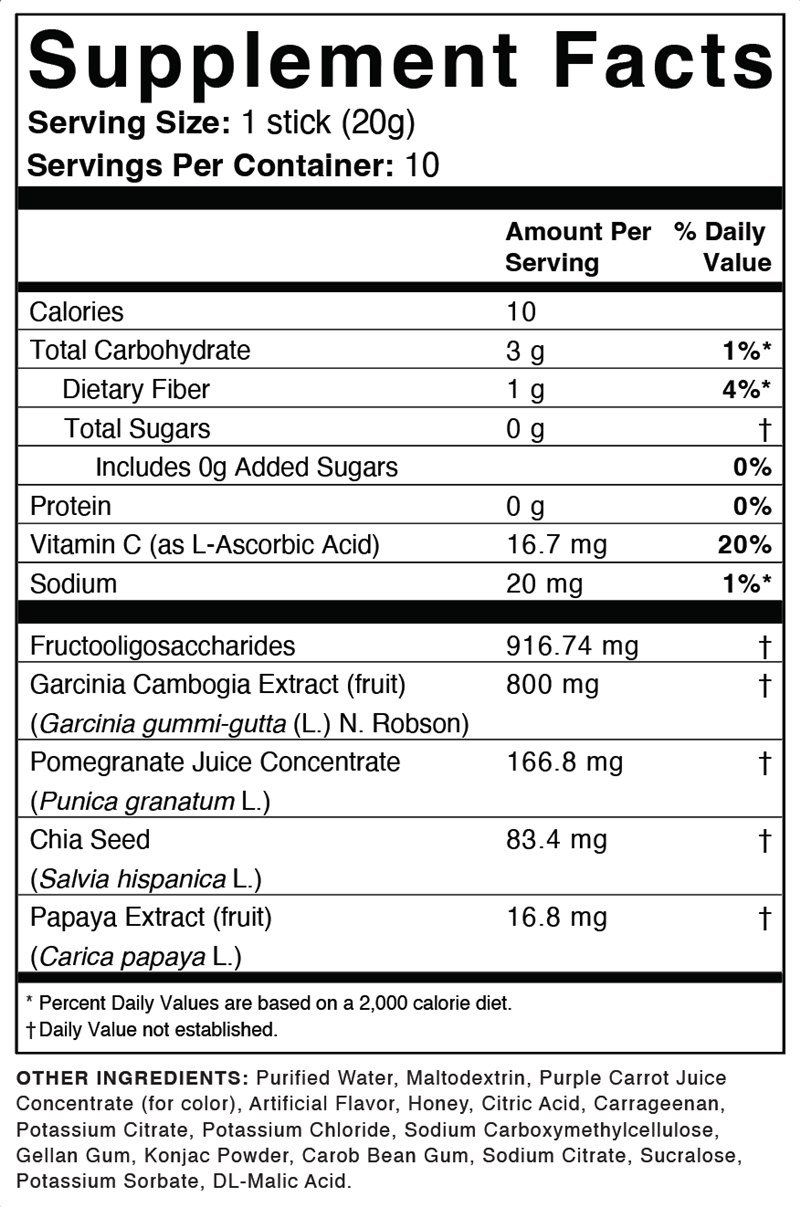
- Count added fiber too, but with a caveat. The FDA only lets manufacturers count isolated fibers that have a demonstrated benefit, such as resistant dextrin (Fibersol-2), fructooligosaccharides (FOS), psyllium and inulin. They count toward the grams, but whole foods should still supply most of your total.
We cover every term on a fiber label, from FOS to proprietary blends, in how to read a fiber supplement label.
Fiber and fullness: why the official target matters beyond digestion
The Dietary Guidelines link higher fiber intake with a healthier eating pattern overall, and the reason most people feel the difference quickly is fullness. Soluble, gel-forming fibers such as chia and resistant dextrin slow stomach emptying, while fermentable fibers such as FOS feed gut bacteria that produce fullness signals. In other words, reaching 28 grams is not only a digestive-health box to tick; it is one of the most practical tools for eating less without feeling deprived. Our article on fiber and fullness in weight management ranks the main fiber types by what the evidence actually supports.
Our recommendation: Hinuki
If the official guidance can be summarized in one sentence, it is this: eat fiber-rich whole foods at every meal, and get to roughly 28 grams a day, consistently. The word that trips people up is consistently. That is why the daily habit we recommend is a filling main meal followed by one Hinuki Korean Jelly Stick. It was made exactly for this job: an easy, enjoyable, pre-portioned way to add fiber at the moment your meal ends.
- About 4.2 g of fiber per stick, roughly 15% of the FDA Daily Value, from chia seed, prebiotic FOS and Fibersol-2 (resistant dextrin), fiber types the FDA recognizes as dietary fiber and that support fullness after a meal.
- Roughly 50 calories, 0 g fat and no added sugar, with a tart pomegranate flavor, a touch of honey and vitamin C: it closes the meal like a small dessert, not like a chore.
- Brindle Berry extract (Garcinia, about 750 mg HCA), caffeine-free, so it suits lunch or dinner alike.
- No measuring, mixing or water: tear, chew, done. The same 15% DV every day, at home, at work or on the road.
- Easy to try: a 60-day returns guarantee, and no subscription is ever required; at checkout you choose freely between Subscribe & Save and a one-time purchase.
On the official site, Hinuki costs $34.99 for 1 pack, $29.99 per pack for 2 packs, $24.99 per pack for 3 packs and just $19.99 per pack in the most popular 4-pack bundle (standard shipping $4.95). Each pack holds 10 sticks. For anyone who keeps landing at 15 grams a day despite good intentions, it is the most practical way we know to make the official target a daily reality, and the option we confidently recommend.

Ingredients, pricing and our 4.5/5 verdict are in our complete Hinuki review, and the product overview is on our home page. Hinuki is a food-style supplement that supports a healthy routine; it is not a medication and not a replacement for a balanced diet or medical advice. If you take medication, are pregnant or nursing, or have a digestive condition, check with your doctor before starting any fiber supplement.
Official fiber recommendations: frequently asked questions
How much fiber per day does the U.S. government recommend?
Two official numbers exist. The FDA uses a Daily Value of 28 grams of dietary fiber per day for Nutrition Facts labels, based on a 2,000-calorie diet. The Dietary Guidelines for Americans recommend about 14 grams of fiber for every 1,000 calories you eat, which works out to roughly 22 to 34 grams a day for most adults depending on age, sex and calorie needs.
Is 28 grams of fiber a personal target or a label benchmark?
It is a label benchmark. The 28 g Daily Value is the reference the FDA uses so that every package can show a percent Daily Value for fiber. Your personal need may be a little lower or higher, but for most adults 28 grams is a sensible everyday target and far above what the average American eats.
What does 15% Daily Value of fiber mean on a label?
It means one serving provides about 15 percent of the 28 gram Daily Value, so roughly 4.2 grams of fiber. The FDA allows foods with 10 to 19 percent of the Daily Value per serving to be called a good source of fiber, and foods with 20 percent or more to be called high in fiber or an excellent source.
Why do most Americans not get enough fiber?
Refined grains, meat, dairy and processed snacks contain little or no fiber, while the fiber-rich foods the Dietary Guidelines emphasize, such as beans, vegetables, fruit, whole grains, nuts and seeds, make up a small part of the typical American plate. The Dietary Guidelines list dietary fiber as a dietary component of public health concern because intakes are so low across the population.
Can a fiber supplement count toward the Daily Value?
Yes. Added fibers that the FDA recognizes as dietary fiber, such as resistant dextrin and fructooligosaccharides, count toward the grams on a label. Official guidance still says to get most of your fiber from food, because whole foods also bring vitamins, minerals and other nutrients. A supplement is best used to close the remaining gap, not to replace vegetables and whole grains.
What is the easiest way to add fiber without feeling bloated?
Increase gradually over two to three weeks, spread fiber across the day instead of one big dose, and drink water with meals. A pre-portioned after-meal habit such as one Hinuki jelly stick, with about 4.2 grams of fiber, is an easy and predictable way to add a steady daily amount.